


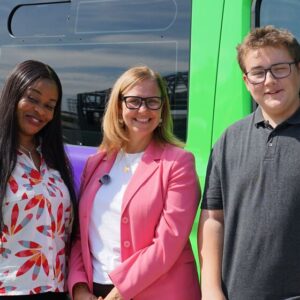
WESTlink reaches 500,000 journeys
WESTlink, the West of England Mayoral Combined Authority’s flexible, bookable transport service, has now provided 500,000 journeys.
Read moreTop line: It is a ‘convenient truth’ that climate mitigating interventions are health beneficial. Reduction in transport-related greenhouse-gas emissions through less motor vehicle use and increases in distances walked and cycled could have important health benefits.
In November 2009 the Lancet Journal launched a series of papers on the co-benefits which can accrue as a direct result of mitigation activities for greenhouse gas emissions.1 A paper by Woodcock et al specifically addressed the public health benefits of strategies to reduce greenhouse gas emissions with regard to land transport.2
In many cities, the increase in use of cars, motorcycles, and HGVs, with the resulting increase in road danger has meant that many individuals who can afford to are changing to private motorised transport. In 2004, transport accounted for almost a quarter of carbon dioxide (CO2) emissions from global energy use. Three-quarters of transport-related emissions are from road traffic. Although large reductions in greenhouse-gas emissions are needed to prevent serious climate destabilisation, emissions from transport are rising faster than from other energy-using sectors and predicted to increase by 80% by 2030.
Researchers used Comparative Risk Assessment methods to estimate the health effects of alternative urban land transport scenarios for two settings—London, UK, and Delhi, India. For each setting, they compared a business-as-usual 2030 projection (without policies for reduction of greenhouse gases) with alternative scenarios—lower-carbon-emission motor vehicles, increased active travel, and a combination of the two. They developed separate models that linked transport scenarios with physical activity, air pollution, and risk of road traffic injury. In both cities, they noted that reduction in carbon dioxide emissions through an increase in active travel and less use of motor vehicles had substantially larger health benefits per million population than from the increased use of lower-emission motor vehicles. However, combination of active travel and lower-emission motor vehicles would give the largest benefits, notably from a reduction in the number of years of life lost from ischaemic heart disease (10—19% in London, 11—25% in Delhi).
Decrease in motor vehicle traffic also has the potential to reduce danger from road traffic. Evidence for safety in numbers suggests that risk declines for each cyclists and pedestrian the more pedestrians and cyclists there are.3 4 Policies to increase the acceptability, appeal, and safety of active urban travel, and discourage travel in private motor vehicles would provide larger health benefits than would policies that focus solely on lower-emission motor vehicles. An increase in the safety, convenience, and comfort of walking and cycling, and a reduction in the attractiveness of private motor vehicle use (speed, convenience, and cost) are essential to achieve the modal shifts envisaged in the research.
1 See http://www.thelancet.com/series/health-and-climate-change (Open Access)
2 See http://www.thelancet.com/journals/lancet/article/PIIS0140-6736(09)61714-1/fulltext?_eventId=login
3 See Essential Evidence No 1. http://www.bristol.gov.uk/ccm/content/Transport-Streets/Walking-Cycling/cycling-in-bristol/essential-evidence/essential-evidence.en
4 Elvik, R. 2009 The non-linearity of risk and the promotion of environmentally sustainable transport, Accident Analysis and Prevention, 41: 849-855.
WESTlink, the West of England Mayoral Combined Authority’s flexible, bookable transport service, has now provided 500,000 journeys.
Read more
Residents across Bristol are being asked for their views on the locations of up to 200 new marked e-scooter and...
Read more
This autumn, businesses and residents are being invited to have their say on proposals to introduce Bristol’s first red route...
Read more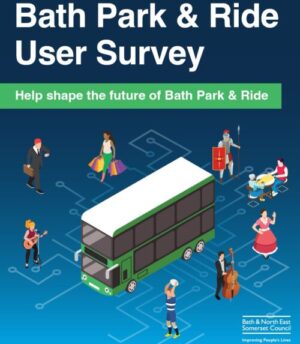
Bath & North East Somerset Council wants to hear from everyone who uses Park & Ride, whether regularly or occasionally....
Read more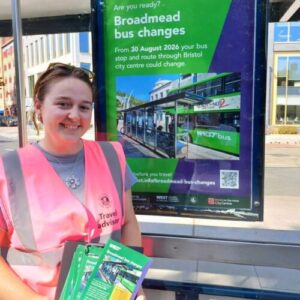
People who get on and off the bus in Broadmead will be able to get advice from a team of...
Read more